
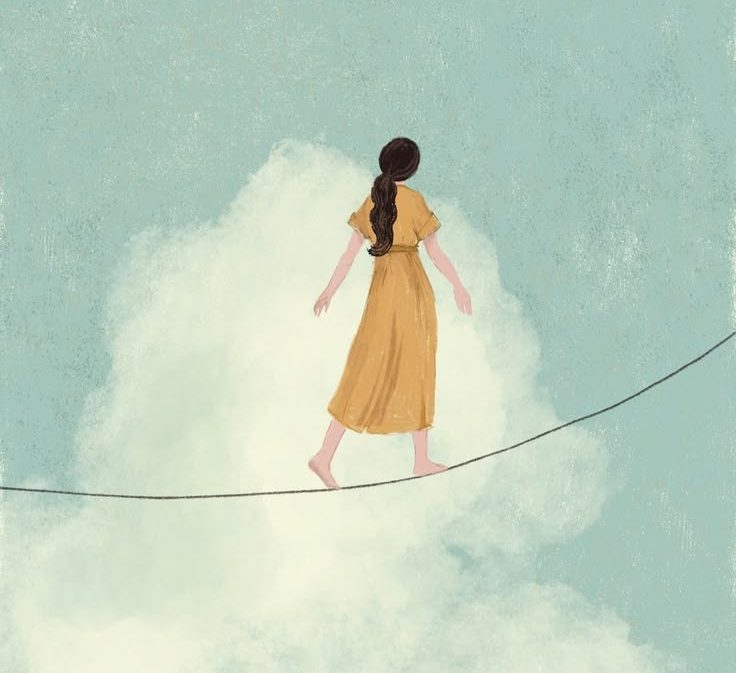
In a cultural context where love is often portrayed as intense, seamless, and free of conflict, many people grow up with the expectation that a relationship should provide a sense of total fulfillment. The idea of finding someone with whom everything aligns where understanding is constant, connection is effortless, and emotional harmony is sustained can be deeply appealing.
However, this ideal, while comforting, is also one of the most frequent sources of frustration in relationships. The difficulty does not lie in love itself, but in the way it is imagined and expected to function.
Not the Problem of Loving, but of Imagining Love
Idealization involves constructing an image of the other person that extends beyond who they actually are. It is shaped by projections expectations, desires, and often unmet needs that are placed onto the relationship with the hope that they will be fulfilled.
In the early stages of a relationship, this process can feel almost natural. There is often a sense of ease, a perception of compatibility, and a tendency to overlook or minimize differences. The other person may appear uniquely aligned with one’s expectations, even experienced as “exactly what I was looking for.”
Yet this experience is not necessarily a reflection of the other person in their entirety, but of the space that idealization creates.
Over time, this space begins to shift. Differences become more visible, limitations emerge, and aspects of the other person no longer align so neatly with the initial image. This is often the moment when tension appears not because love has disappeared, but because the idealized version of the relationship can no longer be sustained.
The Fall of Idealization as a Turning Point
From a clinical perspective, this stage is not a failure of the relationship, but a transition within it. It marks the movement from an imagined form of love to a possible, more grounded one.
However, this shift is not always experienced in those terms. It is often interpreted as a sign that something is wrong. Thoughts such as “this shouldn’t be happening,” “something has changed,” or “maybe this is not the right person” may begin to surface.
What is actually taking place is more complex: an encounter with the reality of the other person, separate from the projections that initially shaped the bond.
Accepting this reality involves recognizing that the other is not there to fulfill every need, resolve every discomfort, or maintain constant emotional alignment. This realization can feel disorienting, as it challenges the initial sense of certainty. Yet it is precisely this shift that allows a relationship to become more authentic and sustainable.
Loving and the Tolerance of Lack
Within psychoanalytic thought, one of the central ideas is that human experience is structured around a sense of lack. Individuals are not complete, not entirely self-sufficient, and not capable of fulfilling all of another person’s needs.
When a relationship is expected to compensate for this lack to fill emotional, psychological, or even existential gaps it becomes burdened with a demand that cannot realistically be met.
In this context, loving does not mean finding someone who completes what is missing, but rather engaging with someone who is equally incomplete. It involves relating to another person in their reality: with their limitations, contradictions, and imperfections, as well as acknowledging one’s own.
This does not imply accepting relationships that are persistently harmful or unbalanced. Rather, it requires developing the capacity to differentiate between what belongs to the inherent imperfection of human relationships and what constitutes genuine harm or incompatibility.
The Risk of Loving Through Illusion
When a relationship is sustained primarily through idealization, a gap tends to emerge between reality and expectation. This gap often becomes a source of ongoing tension.
It may manifest as repeated frustration, a sense that something is always lacking, or difficulty accepting aspects of the other person that do not align with the imagined ideal. In some cases, this can lead to attempts to reshape or “improve” the other person, with the hope that they will eventually fit the expected image.
However, this effort rarely leads to resolution. More often, it generates misunderstanding, disappointment, and emotional distance. The relationship becomes strained not because the other person is inherently insufficient, but because the expectations placed upon them exceed what any individual can realistically embody.
Toward a More Grounded Way of Loving
Developing a healthier relationship often involves letting go of certain fantasies not the desire to love, but the expectation that love should be perfect, constant, or without tension.
To love in a more grounded way is to begin relating to the other as they are, rather than as one wishes them to be. It means recognizing that conflict is not necessarily a sign of failure, but an inevitable aspect of relational life. It also involves accepting that balance, reciprocity, and emotional attunement are not static states, but processes that fluctuate over time.
This form of love is less centered on illusion and more rooted in choice. It requires an ongoing decision to engage with the relationship as it is, rather than as it was imagined.
While this may feel less intense than the initial phase of idealization, it allows for something more stable: a connection that is not dependent on perfection, but sustained through recognition, differentiation, and mutual presence.
A Necessary but Uncomfortable Question
At times, the central difficulty in relationships is not necessarily who one is with, but from where one is relating.
It may be meaningful to ask:
Am I truly getting to know the other person, or am I trying to make them fit what I need?
This question does not always have an immediate or comfortable answer. However, engaging with it can open a different way of understanding relationships—one that is less driven by expectation, and more grounded in reality.